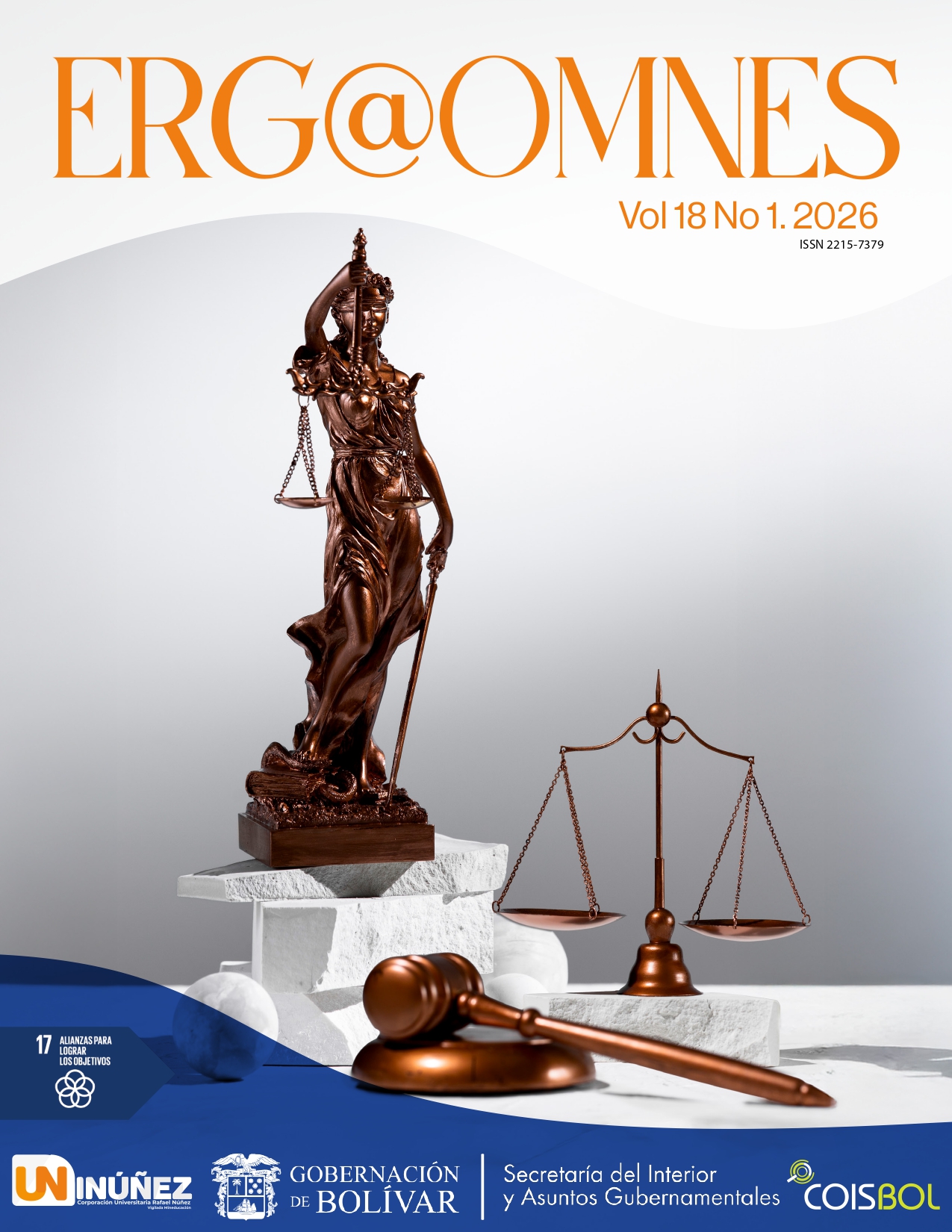
Contexts of Vulnerability and Criminal Responsibility: Associations Between Sociodemographic and Community Factors Among Youth in Bolívar
Keywords:
Contexts of vulnerability, Criminal responsibility of adolescents, juvenile justice, Education and consumption of psychoactive substances.Abstract
This article proposes a sociolegal analysis of the Adolescent Criminal Responsibility System (SRPA) in Bolívar, Colombia, with an emphasis on juvenile criminological vulnerability and its relationship to sociodemographic, social, and community factors. It defends a restorative and social approach within a framework of rights and justice for children and adolescents, drawing on Zaffaroni's theory and key jurisprudence such as ruling C-740/08. The research combines a documentary review and quantitative analysis of official data from 2024 and 2025, obtained from the ICBF (National Criminal Investigation Commission) and the Judicial Branch, to describe SRPA admissions, crime patterns, gender distribution, and geographic location. The RAD method integrates regulations, doctrine, and empirical data and is organized into two phases: a heuristic approach to collecting legal, doctrinal, and statistical information, and a hermeneutic approach to qualitative critical analysis supported by descriptive and comparative temporal approaches. The findings show a marked gender inequality with male predominance (e.g., 136 men versus 9 women among 145 cases in August 2025) and a geographic concentration of crime in vulnerable neighborhoods of Cartagena (Olaya Herrera, La María, Nelson Mandela, Boquilla), indicators of persistent community vulnerability and an increase in cases from 2024 to 2025 that suggests structural failures in prevention. Relevant social factors include incomplete education (mainly between 6th and 9th grade), complex family dynamics, psychoactive substance use and geographic origin from the Caribbean, with the majority of adolescents between 15 and 20 years old and a high level of PAS use (approximately 83% in a sample of 30), with early onset between 11 and 12 years old. Thus, it is concluded that the SRPA in Bolívar reflects structural vulnerability linked to sociodemographic and community factors, reproduces gender biases, and concentrates interventions in areas with greater social disorganization, fueling criticism that the system functions as a mechanism for criminalizing poverty. Based on this, a shift toward preventive and restorative interventions is proposed, with public policies focused on social development, education, and opportunities for adolescents, and a reformulation of SRPA practices toward more preventive, social, and less penalizing responses. This synthesis supports the design of public policies and institutional practices oriented toward restorative justice and effective social inclusion, in accordance with the framework of the Children and Adolescents Code, with an emphasis on territorialized social prevention and investment in human capital in the most vulnerable areas
References
CEPAL. (2019). Panorama Social de América Latina 2018. Comisión Económica para América Latina y el Caribe (CEPAL). Recuperado de https://www.cepal.org/es/publicaciones/44969-panorama-social-america-latina-2019
Colombia. Congreso de la República. (2006). Ley 1098 de 2006. Por la cual se expide el Código de la Infancia y la Adolescencia. Diario Oficial No. 46.446.
Colombia. Corte Constitucional. (2008). Sentencia C-740/08. [Magistrado Ponente: Rodrigo Escobar Gil].
Congreso de la República de Colombia. (2006). Ley 1098 de 2006. Por la cual se expide el Código de la Infancia y la Adolescencia. Diario Oficial No. 46.446.
Congreso de la República de Colombia. (2015). Ley 1751 de 2015. Por medio de la cual se regula el derecho fundamental a la salud. Diario Oficial No. 49.433.
Corte Constitucional. (2008). Sentencia C-740/08. Magistrado Ponente: Rodrigo Escobar Gil.
Corte Constitucional. (2013). Sentencia T-497/13. Magistrada Ponente: María Victoria Calle Correa.
Gómez, Y. A., & Mejía, J. A. (2024). Análisis de los Factores que Inciden en la Delincuencia Juvenil. Repositorio CDIM. Recuperado de https://repositoriocdim.esap.edu.co/bitstream/handle/20.500.14471/27866/G%C3%93MEZ%20MEJ%C3%8DA%20YAHAIRA%20ALEJANDRA.pdf?sequence=1&isAllowed=y
ICBF. (2022). Aproximación a la situación de salud de los adolescentes y jóvenes vinculados al Sistema de Responsabilidad Penal... Ministerio de Salud y Protección Social. Recuperado de https://www.minsalud.gov.co/sites/rid/Lists/BibliotecaDigital/RIDE/VS/PP/situacion-salud-jovenes-srpa-2021.pdf
Ley 1098 de 2006. Por la cual se expide el Código de la Infancia y la Adolescencia. Diario Oficial No. 46.446.
Presidencia de la República de Colombia. (2015). Decreto 1885 de 2015. Por el cual se crea el Sistema Nacional de Coordinación de Responsabilidad Penal para Adolescentes (SNCRPA) y se dictan otras disposiciones. Diario Oficial No. 49.642.
UNICEF. (2006). Convención sobre los Derechos del Niño. Organización de las Naciones Unidas.
Zaffaroni, E. R., Alagia, A., & Slokar, A. (2002). Derecho penal: Parte general. Sociedad Anónima Editora.
Downloads
Published
Issue
Section
License

This work is licensed under a Creative Commons Attribution 4.0 International License.

Esta obra está bajo una Licencia Creative Commons Atribución 4.0 Internacional.